A well-organized and structured documentation set is key to a project's success. Managing and implementing top-tier Architectural Graphical Standards is crucial. This article explores the most relevant aspects to consider when building the set.
Although robotics and AI are advancing construction alongside BIM, most projects still rely on 2D drawings. These provide the information and instructions that enable general contractors and tradespeople to build on-site. Whether digital or printed, 2D drawings form part of the 'Contract Documents', legally binding documents used for reference or dispute resolution until the industry moves to model-based delivery contracts.
This highlights the importance of understanding standards, following documentation rules, and keeping pace with client definitions.
Our technical leaders hosted three lunch-and-learn sessions to share their project-based expertise on structuring, developing, and managing documentation. The following is a summary to keep and share.
About Architectural Graphical Standards
First things first, understanding that drawings are “the source of all truth” for construction information is key to handling documentation. Then, it becomes evident that order is critical for a clear understanding of the project. The main concept for structuring a proper Documentation Set is to read it from the most general to the most detailed aspects, in an organic, coordinated, and well-thought-out way, with an understanding of the set as a whole. Although it may seem obvious, using the same paper size across all disciplines is necessary for consistent referencing and coherent numbering.
We believe 'Victory loves preparation', so projects don't create drawings on the go. A Mock-Up or Cartoon Set is a preliminary set of drawings used to estimate the number of sheets needed for a particular project. The type, complexity, and size of a project will impact how it is designed. This preliminary set can be developed once definitions are in place for sheet size, the number of drawings to set up, and the drawing scales to be used. This information may be defined as a prerequisite by the client – or even as part of a contractual agreement – and should result from a thoughtful design and approach.
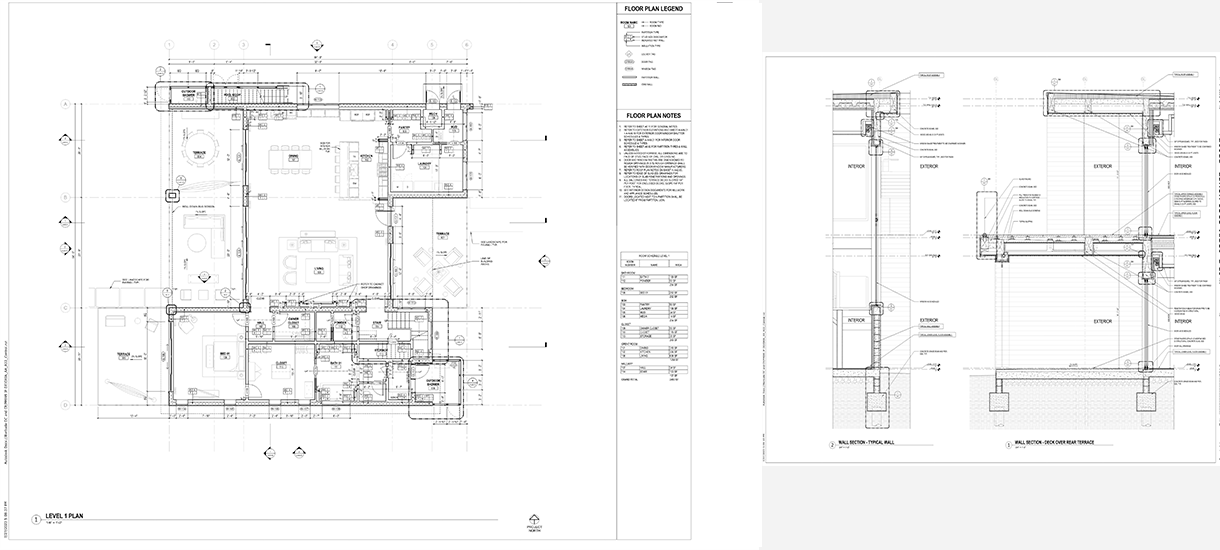
Key elements to define a winner documentation strategy
There are basic documentation rules that contribute to a clear understanding of the project and can be reverse-engineered to design it. Here are our top 5:
#1 Information is always read from general to particular, expanding on the information as needed.
#2 An Index is a great tool to use as a map for navigating the set.
#3 Non-graphical elements should be present in drawings. They are critical to understanding the project as a whole and provide general information that complements other views. These include the cover sheet, general notes, legends, keynotes, annotation symbols, schedules, and more.
#4 Having a complete, agreed-upon title block is key to consistency and the identification of drawings. Information of the parties involved, revisions, scales, subject, and positioning of the views are included in this element.
#5 Checking the visibility of each view, its graphical representation, sizing, and the positioning of annotation elements, patterns, etc., is critical to ensuring the clarity of information.
Working with structured architectural graphical standards saves time, ensures consistency throughout the project (from templates to text styles), reduces rework and misunderstandings, and is highly scalable.
Clear standards also enable automation and tool implementation to speed up the process by simplifying exports, quality control, and view/sheet creation.
The importance of dimensions
Dimensioning is a crucial aspect of documentation. It indicates the actual size of elements in the project, but should be placed strategically and thoughtfully. Not every drawing piece should include every dimension. Knowing when to include or omit a dimension is the difference between a clear, useful drawing set and a complicated, cluttered one that can lead to misunderstandings on-site.
The first important step to deliver high-quality documentation is to know whether the client has sample sets and standards to guide the work. Complying with those and confirming the criterion to be implemented will be key to providing an acceptable set.
Secondly, and perhaps the most difficult for architectural professionals, is to avoid over- or under-dimensioning an object or drawing piece.
Having just the right amount of information is an art that grows with experience. It is the difference between a clear, easy-to-read drawing and a complex and encumbered piece.
Dimensions should be placed outside the object boundaries whenever possible, and aligned and grouped to enhance the overall legibility, clarity, and consistency of the drawing.
Implementing these references and guidelines will significantly improve your drawing sets. If you have difficulties with the quality of your or your vendors' documentation, reach out to us. We can help you define a strategy to take your production to the next level. Let’s get in touch!
Read the first chapter of these learning sessions: Building systems.

